
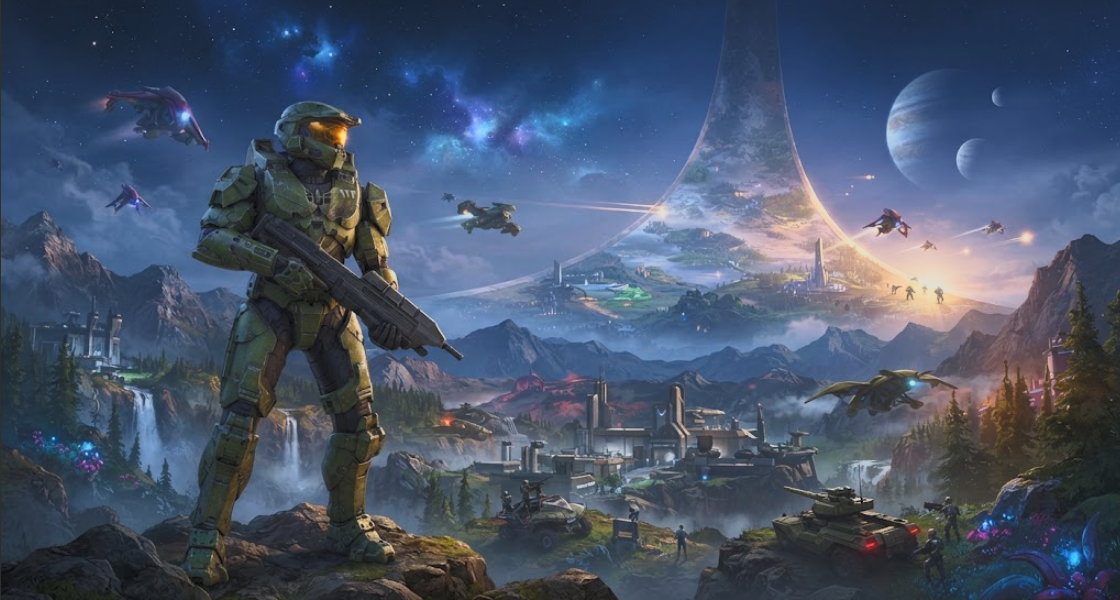
For more than two decades, a simple Gregorian chant harmonic has been enough to give millions of players worldwide goosebumps. From the very first notes, the mind escapes to titanic rings lost in the immensity of the cosmos, abandoned cities of glass, and the iconic helmet of a green steel giant. Halo is much more than a simple military science fiction franchise; it is a true cultural monument that redefined the contours of modern gaming, propelling Microsoft’s Xbox onto the international stage and branding the collective imagination of an entire generation.
Genesis of a Titan: From Military Strategy to FPS Legend
Halo’s history reads almost like an industrial miracle. At the turn of the millennium, developer Bungie, then based in Chicago, envisioned an ambitious real-time strategy (RTS) game for Macintosh and Windows computers. At the time, the project was simply called Blam! before finding its final name. Players commanded armies on a mysterious ring-world.
The franchise’s destiny shifted in 2000 when Microsoft acquired Bungie. Phil Spencer and the Xbox division desperately needed a flagship title to launch their very first home console against established giants Sony and Nintendo. The project was subsequently transformed into a first-person shooter (FPS). This bold gamble gave birth to Halo: Combat Evolved, released in 2001 alongside the Xbox console.
Upon release, the game rewrote the rules of the genre on consoles. Unlike the standards of the era that struggled to adapt controls to a gamepad, Halo offered intuitive ergonomics, an innovative health regeneration system that spared players the frustration of medkits, and an arsenal of surgical precision. Above all, it introduced a rich universe anchored in a desperate war of attrition between Humanity, threatened with extinction, and a theocratic alien alliance known as the Covenant. At the center of this epic stood the Master Chief (John-117), a super-soldier forged in silence and efficiency, flanked by Cortana, an artificial intelligence as sarcastic as she was brilliant.
The Original Trilogy and the Golden Age of Multiplayer
While the first installment laid the foundations, its sequel, Halo 2 (2004), transformed the franchise into a genuine societal phenomenon. By introducing large-scale structured online gaming via Xbox Live, Halo 2 revolutionized console multiplayer. Wild online matches, clans, a ranking system, and legendary maps like Lockout or Midship created a passionate and fiercely loyal community. The story also expanded by allowing players to step into the shoes of the Arbiter, a disgraced Covenant commander, offering a political and nuanced perspective on the galactic conflict.
The conclusion of this first grand era arrived in 2007 with Halo 3. Propelled by the famous « Believe » marketing campaign, the game shattered entertainment industry launch records. It delivered an epic conclusion to the trilogy, where the Chief had to prevent the Covenants from activating all the Halo rings—an act that would spell the eradication of all sentient life in the galaxy—while confronting the Flood, a terrifying parasitic life form capable of assimilating any organism.
Following Bungie’s departure from Microsoft’s umbrella, 343 Industries took up the mantle, carrying the torch with the Reclaimer trilogy (Halo 4, Halo 5: Guardians) and the widely praised return to roots with Halo Infinite in 2021. Each iteration further deepened the dizzying lore of the universe, exploring the origins of the Forerunners, the rings’ vanished builders, and the mysteries of the Precursors.
The Expanded Universe: Novels, Comics, and the Quest for Audiovisual Adaptation
Halo’s true power lies in its ability to transcend the boundaries of video games. Very early on, the universe branched out through a plethora of cult novels penned by renowned authors like Eric Nylund and Greg Bear. These books explored the harshness of the Spartan-II program, the abduction of children to turn them into war machines, and the geopolitical complexity of the UNSC (United Nations Space Command).
For years, fans dreamed of seeing this military space opera land on the big screen. Big Hollywood names, from Peter Jackson to Neill Blomkamp, attempted to bring the Master Chief to life in theaters. The film project unfortunately bogged down in the quagmire of production hell, falling victim to budget and creative disagreements between Microsoft and Hollywood studios.
Hope was finally reborn on the small screen with the Halo television series, which premiered in 2022 on Paramount+. Set in an alternative timeline (the « Silver Timeline »), the show made the bold choice to deviate from the official game canon to explore the Master Chief’s human psyche, going as far as removing his helmet multiple times—an artistic decision that deeply divided the core community. Despite spectacular action sequences and a substantial budget, the series struggled to strike a lasting narrative balance, leading to its cancellation after two seasons and leaving fans nostalgic for an adaptation more faithful to the original source material.
Ghosts of the Cosmos: Abandoned Projects and Untrodden Paths
Behind the franchise’s blazing success lies a graveyard of aborted projects that continue to fuel the fantasies of video game archaeology enthusiasts. Among the most famous is undoubtedly Halo Chronicles, a collaborative project led by Peter Jackson in the mid-2000s. Conceived as an interactive narrative experience halfway between a game and a film, this title was meant to explore the Halo universe from a completely unprecedented angle before being quietly canceled.
Gamers also remember the ambitious Halo MMO project (often referred to under the codename Titan or the project spearheaded by Ensemble Studios), which aimed to transpose the war against the Covenant into a large-scale persistent world. Canceled before it could even be fully unveiled, it stands as a testament to Microsoft’s constant drive to explore new horizons for its cash cow. Even regarding spin-offs, tactical or stealth concepts centered around the ODSTs (Orbital Drop Shock Troopers) were frequently sketched before being reworked, much like the stellar Halo 3: ODST, which repurposed some of those ambitions to deliver a noir-drenched atmosphere inside a ravaged city.
The Timeless Appeal: Why Halo Still Resonates Within Us
How can we explain why, after more than twenty years, the flame of Halo has never truly died out? The answer lies in the power of its symbols. The massive silhouette of the Master Chief, armed with his assault rifle and protected by a golden visor reflecting the stars, has become the ultimate archetype of the modern knight. He is a silent hero who allows players to project themselves entirely into his armor, embodying humanity’s last bastion against the unknown.
The soundtrack, composed primarily by Martin O’Donnell and Michael Salvatori, plays an equally fundamental role. This bold blend of sacred chants, tribal percussion, and futuristic synthesizers infuses an almost mythological dimension into battles that are otherwise technological. Exploring a ring-world is akin to treading the soil of an ancient alien temple, where every metallic corridor conceals the secrets of a fallen civilization.
Halo also shaped modern online gaming culture. For millions of players, hours spent playing splitscreen on the couch, battling across Blood Gulch or helping each other through Legendary difficulty, remain indelible memories.
Ultimately, Halo transcends mere interactive entertainment. It is a timeless space odyssey, a fresco where the purest heroism brushes up against the existential dread of annihilation. As long as silent rings spin in the void of space and artificial intelligences are willing to sacrifice themselves to save humanity, the legend of the Chief will continue to illuminate the firmament of video games.