
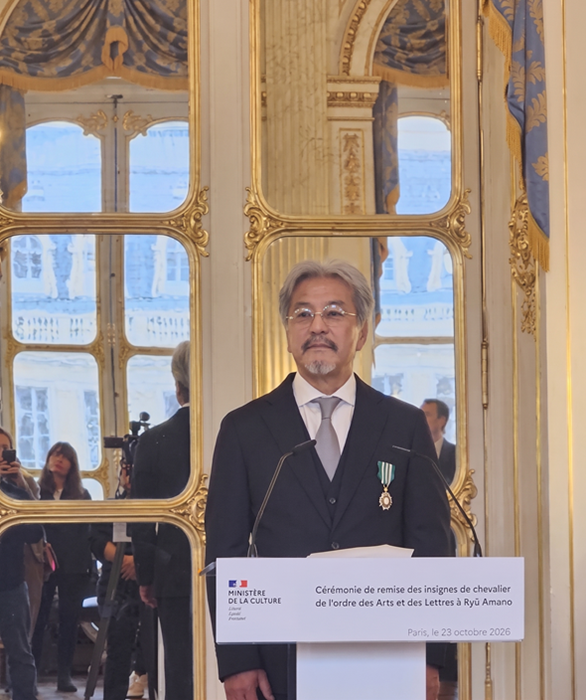
The video game universe celebrates a major new recognition of its status as a full-fledged art form. On Friday, October 23, 2026, Eiji Aonuma, the renowned producer of The Legend of Zelda franchise, was officially elevated to the rank of Knight of the Order of Arts and Letters. This prestigious distinction, presented at the Ministry of Culture in Paris alongside the Paris Games Week 2026, crowns an exceptional career dedicated to video game innovation and the enchantment of millions of players worldwide. From his humble beginnings as a designer to the overall supervision of one of the most acclaimed sagas in Nintendo’s history, Eiji Aonuma’s journey is that of a visionary creator. This article traces the biography, impressive curriculum vitae, and history of this artisan of dreams, recently decorated by the French state.
A Historic Ceremony in the Heart of Paris
The event took place under the gilded ceilings of the French Ministry of Culture. On October 23, 2026, during a solemn ceremony immortalized by numerous photographs bearing witness to the event, Eiji Aonuma received the insignia of Knight of the Order of Arts and Letters. This appointment was not decided overnight; it had been publicly announced in advance, back in November 2023, by Rima Abdul-Malak, who then served as the Minister of Culture. As a foreign national, the protocol procedure also required a favorable opinion from the Ministry of Foreign Affairs, highlighting the strong diplomatic and cultural dimension of this official tribute.
Emotion was undeniably palpable during the Japanese producer’s acceptance speech. Demonstrating the human warmth that often characterizes his public appearances, he addressed his vast community of fans sincerely, declaring: « Thank you for following me this far, let’s continue the adventure together. » This poignant statement elicited deep emotion within the Parisian audience, revealing a deeply intimate and personal facet of a creator who is usually discreet.
By receiving this medal, Eiji Aonuma does not merely etch his name into the history of Franco-Japanese cultural relations. He joins a very select circle of iconic figures from the video game industry who have also been honored by France, following renowned creators such as Michel Ancel, Frédérick Raynal, and his illustrious colleague at Nintendo, Shigeru Miyamoto. This official distinction highlights the central role of Japanese creators in the global expansion of this entertainment medium and further strengthens video games’ status as a major artistic domain.
Biography and Genesis of a Master Designer (1963 – 1996)
To understand the scope of Eiji Aonuma’s work and philosophy, one must look back at his early years. Born on March 16, 1963, in Nagano Prefecture, Japan, Eiji Aonuma initially pursued a very academic path oriented toward traditional creation. He completed his higher education at the Tokyo National University of Fine Arts and Music (known as Tokyo University of the Arts), a prestigious institution from which he officially graduated in 1988.
Armed with this solid artistic background, he joined Nintendo that same year in 1988, beginning a long professional career that would permanently transform the entertainment industry. His first steps within the development teams were dedicated to the visual aspect. He first distinguished himself as a graphic designer and sprite artist, actively participating in the development of NES Open Tournament Golf, a sports title released in 1991, marking his very first concrete foray into video game creation at Nintendo.
His technical talent and global vision were quickly noticed by the company’s management. In 1996, he reached a decisive milestone by taking on the key role of director for the game Marvelous: Mouhitotsu no Takarajim (Marvelous: Another Treasure Island). Although less internationally publicized, this adventure game represents a cornerstone in his professional trajectory. The architecture of the title was heavily influenced by the mechanics of The Legend of Zelda: A Link to the Past. This major project allowed him to successfully demonstrate his ability to lead a complete team and revealed his innate affinity for puzzle-solving and dungeon design, thus laying the foundations for his future role.
The Meteoric Rise: Taking the Reins of The Legend of Zelda
The fundamental turning point in Eiji Aonuma’s career occurred in the late 1990s. After proving his mettle, he joined the development team for what would become one of the most revolutionary games in history: The Legend of Zelda: Ocarina of Time, released in 1998. Serving as co-director on the Nintendo 64 console, he played an active role in conceptualizing this three-dimensional universe and deeply absorbed the franchise’s DNA. This event marked the starting point of his nearly exclusive involvement in the The Legend of Zelda series, a responsibility he has held continuously since 1998.
His hard work on Ocarina of Time was deemed so exceptional that Shigeru Miyamoto, the original creator of the license, gradually decided to hand over the keys to the world of Hyrule to him. Starting in 2000, Aonuma again took on the role of co-director for the atypical The Legend of Zelda: Majora’s Mask. He then masterfully followed up by directing The Legend of Zelda: The Wind Waker in 2002, a game that left a lasting impression with its distinct artistic direction and narrative audacity.
Faced with market challenges and fluctuating public expectations in the West, Aonuma demonstrated a sharp sense of strategic adaptation. Following the disappointing commercial performance of Four Swords Adventures in Japan, he decided to reorient the franchise to specifically target Western player expectations when designing The Legend of Zelda: Twilight Princess (released in 2006). As he anticipated, the title became a massive success in the United States and Europe, proving his keen reading of the global industry.
Across console generations, his role at Nintendo evolved from operational director to chief producer and absolute supervisor of the entire saga. He thus presided over the development of recent monumental video games that rethought the fundamentals of the open-world series with the groundbreaking The Legend of Zelda: Breath of the Wild (2017) and its ambitious successor, The Legend of Zelda: Tears of the Kingdom (2023).
Eiji Aonuma’s Exceptional CV
To quantify the impact of this Knight of the Order of Arts and Letters on popular culture, here is a summary of the major positions defining his rich curriculum vitae:
- Civil Status: Eiji Aonuma (青沼 英二), born March 16, 1963.
- Academic Background: Graduate of Tokyo University of the Arts in 1988.
- Global Career (1988 – Present): Project Manager and Producer at Nintendo.
- 1991: NES Open Tournament Golf (Sprite Designer).
- 1996: Marvelous: Mouhitotsu no Takarajim (Director).
- 1998: The Legend of Zelda: Ocarina of Time (Co-director).
- 2000: The Legend of Zelda: Majora’s Mask (Co-director).
- 2002: The Legend of Zelda: The Wind Waker (Director).
- 2004: The Legend of Zelda: The Minish Cap (Supervisor).
- 2006: The Legend of Zelda: Twilight Princess (Director).
- 2007 – 2013: Successive Producer on Phantom Hourglass (2007), Spirit Tracks (2009), Skyward Sword (2011), and A Link Between Worlds (2013).
- 2017: The Legend of Zelda: Breath of the Wild (Producer).
- 2023: The Legend of Zelda: Tears of the Kingdom (Producer).
- 2024: The Legend of Zelda: Echoes of Wisdom (Producer).
Currently, he continues his duties by overseeing the entire historical saga with care, meticulously monitoring its evolution and narrative coherence.
The Creative Future of the Master of Hyrule
Eiji Aonuma’s legacy is far from a closed chapter. Although he recently served as a producer on The Legend of Zelda: Echoes of Wisdom released in 2024, the industry is abuzz with massive expectations regarding a highly desired future remake or title on Nintendo’s next console, commonly referred to as the Switch 2. The fortunate temporal coincidence between this Parisian honorary ceremony in October 2026 and the approaching highly anticipated commercialization of Nintendo’s next major hardware platform greatly reinforces the feeling of total achievement for the producer.
Beyond role-playing game production, Aonuma remains a multifaceted artist. Initially trained in classical creation, he maintains a great passion for music. He plays various instruments, including the ocarina, and plays percussion in an internal company orchestra. This musical ensemble, which brings together more than 70 members from the manufacturer’s workforce, is aptly named « The Wind Wakers » (with Aonuma even conducting this instrumental formation during their private performances).
By receiving the honors of the French Republic, Eiji Aonuma sees his lifelong dedication rewarded at its true value. Throughout his immense career, he has forged an unbreakable bond with his virtual creations. Illustrating his deep commitment to the design process, he once confessed: « I started thinking about all the horrible trials Link had to overcome during his journeys in the new game. I realized that Link is truly my other child. » This spiritual and artistic paternity, now recognized and praised by France’s highest cultural institutions, forever consecrates Eiji Aonuma as one of the greatest universe builders of our contemporary era.