Description
Hisense has disrupted the global television market by offering cutting-edge technologies at ultra-competitive prices. Once considered an underdog, the manufacturer is now a major leader, directly competing with historical giants thanks to major advancements in Mini-LED and laser projection.
Understanding the Hisense lineup requires looking at its proprietary innovations. Whether you are looking for a giant screen for sports, a hyper-responsive panel for video games, or an affordable alternative to the very high-end, here is a breakdown of current Hisense technologies.
1. ULED and Mini-LED: Mastering Brightness
Hisense’s striking force relies on its proprietary naming: ULED (Ultra LED). It is not a new panel technology per se, but rather a set of hardware and software optimizations (backlighting, colorimetry via Quantum Dots, image processing) applied to high-quality LCD panels.
The Rise of Mini-LED Pro
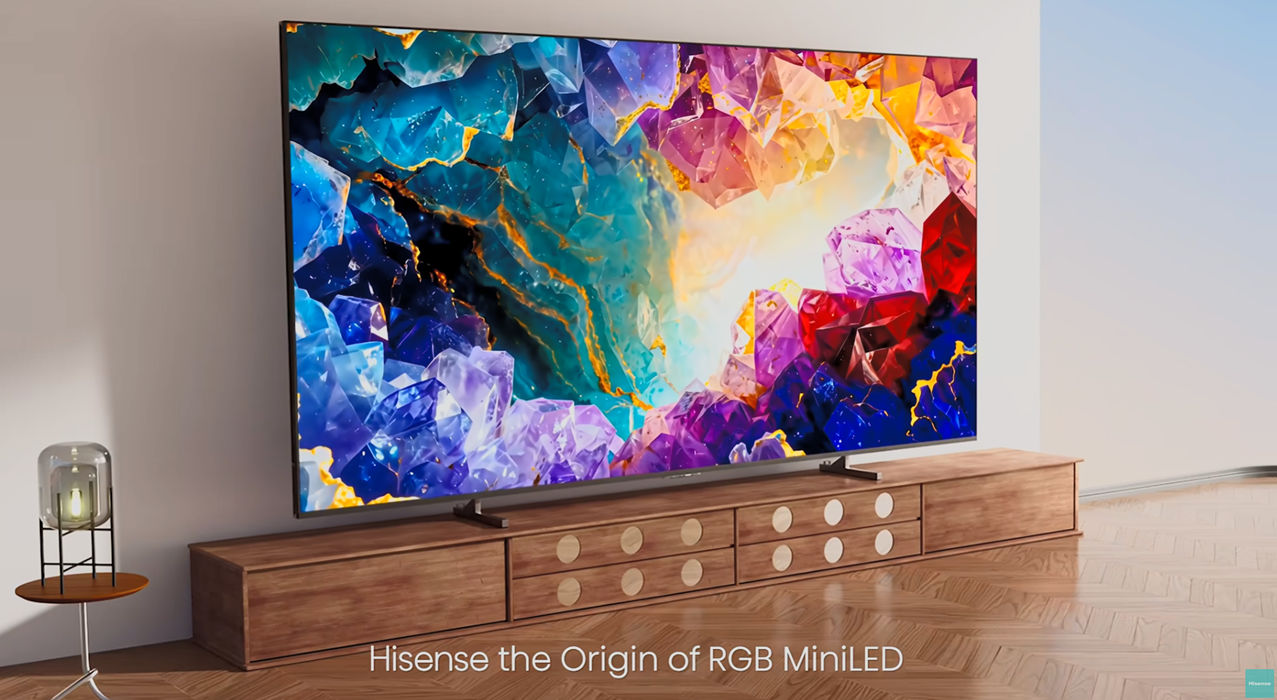
On its high-end models (like the U8 series or the premium UX range), Hisense integrates Mini-LED. By replacing traditional LEDs with thousands of miniature diodes, the screen benefits from extremely fine Local Dimming, spread across thousands of independent zones.
This technology allows Hisense televisions to reach dazzling brightness peaks, regularly exceeding 2000 nits, and even 5000 nits on flagship models (UX series). It is the ideal technology for very bright living rooms. Blacks are deep, the risk of burn-in is nonexistent, and the blooming effect around bright objects on a dark background is drastically reduced thanks to the Hi-View Engine image processor.
2. Laser TV and Laser Cinema: The Giant Screen Reinvented
Where Hisense radically stands out from the competition is with its Laser TV and Laser Cinema range. Rather than a traditional glass panel, these are ultra-short-throw projectors designed to replace the traditional television.
-
TriChroma Technology: The most advanced models use three pure lasers (red, green, blue) to generate the image, offering a color volume that exceeds digital cinema standards (over 100% coverage of the BT.2020 color space).
-
ALR Screen: Laser TVs come with a technical anti-glare (Ambient Light Rejecting) screen that blocks light from the ceiling and windows to only reflect light from the projector, allowing for daylight use.
-
Advantages: This technology allows for massive diagonal sizes (100 or 120 inches) at a reduced cost and footprint compared to a giant LCD screen. Furthermore, since the light is reflected rather than emitted directly toward the eyes, visual fatigue is considerably reduced.
3. Home Cinema: HDR and Universal Compatibility
For home cinema, Hisense adopts a pragmatic and universal approach that is highly appreciated by cinephiles.
The Strength of Universality (Dolby Vision IQ and HDR10+)
Unlike some manufacturers that impose a single format, mid-range and high-end Hisense televisions support all dynamic HDR formats: HDR10+ and Dolby Vision.
The Dolby Vision IQ (and HDR10+ Adaptive) variation uses the television’s light sensor to dynamically adjust the film’s colorimetry and contrast based on your room’s ambient lighting. The Hi-View Engine processor, supported by artificial intelligence, analyzes each scene to optimize sharpness and upscale HD content with great clarity.
4. Video Gaming: Game Mode Pro and Ultra-Fluidity
Hisense has not neglected PC players and next-generation console (PS5, Xbox Series X) owners. The U7 and U8 series are tailored for competition and immersive gaming.
By activating Game Mode Pro, Hisense televisions deploy their technical arsenal:
-
144 Hz Refresh Rate: Ideal for PC gamers seeking maximum fluidity in shooting or racing games.
-
VRR (Variable Refresh Rate) and AMD FreeSync Premium Pro: Dynamically synchronizes the screen’s refresh rate with the console to eliminate screen tearing and stuttering, while maintaining HDR effects.
-
HDMI 2.1 Connectivity: High-bandwidth ports are present to support 4K flow at 120 frames per second (or 144 Hz).
-
Game Bar: An overlaid contextual menu allows you to adjust the aspect ratio, check the FPS rate in real-time, and optimize input lag (which regularly drops below the 15 ms mark).
5. The VIDAA Interface: Simplicity and Responsiveness
While Hisense offers Google TV in some international markets, the manufacturer equips the vast majority of its European models with VIDAA, its own operating system.
VIDAA stands out for its lightweight nature and execution speed. Booting up the TV and launching major apps (Netflix, Prime Video, Disney+, YouTube) is almost instantaneous. The interface is clean, easy to master, and natively integrates voice assistants (Alexa and VIDAA Voice) directly accessible via the remote control microphone. Although its app store is less comprehensive than Android TV’s, the user experience compensates with remarkable daily fluidity.
Whether braving daylight with the power of Mini-LED, creating an immersive home theater with a Laser TV, or playing at a high level thanks to 144Hz panels, Hisense now offers a mature technological ecosystem. The brand stands out as a premier rational choice, delivering cutting-edge performance and an ultra-comprehensive feature set at a particularly aggressive price point.