Description
A Fascinating Dive into the Origins of Panem
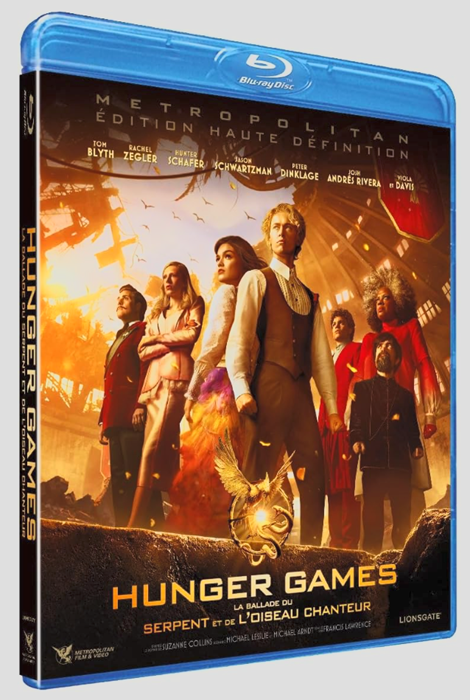
The return of the famous dystopian franchise to theaters created a major cinematic event with The Hunger Games: The Ballad of Songbirds and Snakes. Far from simply recycling the formula of the original films driven by Katniss Everdeen, this prequel ventures into much darker and more psychological territory. By adapting the eponymous novel by Suzanne Collins, director Francis Lawrence takes us back sixty-four years before the events of the first film, right into the heart of a Capitol still scarred by the districts’ rebellion. This feature film does not merely expand the mythology of Panem; it redefines our understanding of the games and explores the genesis of the most feared tyrant in this universe: President Snow.
An Unexpected But Brilliant Return to Suzanne Collins’s Universe
The announcement of a new chapter in The Hunger Games universe sparked both excitement and apprehension. Cinematic prequels are often a perilous exercise. However, Suzanne Collins’s literary work offered an exceptionally rich narrative foundation, centered not on a virtuous hero, but on the slow corruption of a brilliant young man. The film adaptation, faithful to this spirit, takes the time to establish its stakes. We discover a Capitol that is not yet the extravagant and technologically supreme metropolis we know. It is a city undergoing reconstruction, marked by war, where the elites struggle to maintain their status.
The choice to bring Francis Lawrence back behind the camera proved highly judicious. The director, who previously helmed Catching Fire and both parts of Mockingjay, perfectly masters the aesthetics and codes of this universe. He infuses The Ballad of Songbirds and Snakes with a fascinating retro-futuristic atmosphere, recalling post-war architecture and mid-20th-century totalitarian regimes, while retaining the visual DNA unique to the saga.
The Story of Coriolanus Snow: From Ambitious Student to Ruthless Tyrant
The beating heart of this film is undeniably the character of Coriolanus Snow. Forget the Machiavellian old man with the poisonous smile portrayed by Donald Sutherland. Here, played by the excellent Tom Blyth, Snow is an 18-year-old student from a noble family left ruined by the war. He hides his poverty behind a facade of academic excellence and devouring ambition. His only chance to restore the House of Snow to its former glory is to win the prestigious Plinth Prize, which will guarantee his future at the university.
The film excels in transcribing his moral descent into hell. Coriolanus is not born a monster. He is a product of his environment, torn between his emerging noble sentiments and his visceral desire for power and security. Tom Blyth delivers a nuanced performance, letting the flaws and the glacial intelligence of the future president shine through. The viewer is placed in an uncomfortable position: catching oneself feeling empathy for this young man fighting for social survival, all while knowing exactly the monster he is destined to become. Every decision he makes, every ethical compromise he accepts in order to win, lays the bricks of the dictatorship he will erect decades later.
Lucy Gray Baird: The Songbird Who Defied the Capitol
Standing against the snake Snow is the songbird, Lucy Gray Baird, magnetically portrayed by Rachel Zegler. The female tribute from District 12, she represents the exact opposite of Katniss Everdeen. Where Katniss was a taciturn survivor, a fearsome hunter shying away from the spotlight, Lucy Gray is a performer, a charismatic musician belonging to a traveling troupe called the Covey. Her Reaping scene immediately sets the tone: she does not rebel through physical violence, but through art, theatrical defiance, and a provocative song.
Rachel Zegler brings a theatrical and vocal dimension that is indispensable to the film. The songs, performed live on set, are not mere musical interludes. They are acts of political resistance, tools for crowd manipulation, and vessels of raw emotion. The dynamic between Lucy Gray and her mentor, Coriolanus, forms the backbone of the narrative. Their relationship possesses a fascinating ambiguity, blending mutual manipulation, genuine romance, and a sheer instinct for survival. Lucy Gray uses Snow’s charm to survive in the arena, while Snow uses Lucy Gray’s talent to shine in the eyes of the Capitol.
The 10th Hunger Games: Raw Brutality
One of the most captivating aspects of The Hunger Games: The Ballad of Songbirds and Snakes is the depiction of the 10th Hunger Games. We are far removed from the high-tech domes, virtual forests, and sophisticated genetic mutations of the 74th games. The arena is nothing more than a ruined amphitheater, a remnant of the war’s bombings. The tributes are herded like animals into zoo cages, starved and stripped of all human dignity even before the massacre begins.
This crudeness paradoxically makes the games even more terrifying. The action is visceral, messy, and devoid of any glamorous staging. It is precisely at this pivotal moment that the organizers, led by the ruthless Dr. Volumnia Gaul (brilliantly played by Viola Davis), realize that the games must evolve. For the citizens of the Capitol to keep watching this morbid spectacle, it is no longer enough to punish the Districts; the slaughter must be transformed into entertainment. Thus, Coriolanus suggests the introduction of betting, sponsors, and audience involvement, laying the groundwork for the cynical machinery we will encounter sixty-four years later.
The Crucial Role of Dr. Volumnia Gaul and Casca Highbottom
Snow’s evolution would not be complete without the influence of his mentor figures, who act as distorting mirrors to his soul. On one side, we have Casca Highbottom (Peter Dinklage), the dean of the Academy and the inadvertent creator of the Hunger Games. Consumed by guilt and addicted to morphling, he harbors a fierce hatred for Coriolanus because of his father’s sins. His bitterness serves as a constant reminder of past horrors and the futility of this violence.
On the other side, Dr. Volumnia Gaul is the true architect of Panem’s cruelty. As the Head Gamemaker, she is a sadistic scientist who perceives humanity as fundamentally savage and violent. Her macabre experiments in her underground laboratories foreshadow the monstrous creations of future games. She is the one who shapes Coriolanus’s mind, forcing him to confront his own capacity to kill and betray. The dynamic between these three characters offers a deep philosophical reflection on human nature, the social contract, and the origins of tyranny.
Why This Prequel is an Essential Work for the Franchise
For longtime fans, The Ballad of Songbirds and Snakes is a veritable treasure trove of lore and mythological explanations. The film answers many lingering questions. Where do the famous « Mutts » (genetic mutations) come from? Why does President Snow hate Mockingjays so much? And above all, what is the true origin of the rebel song The Hanging Tree?
Discovering that the anthem of the rebellion, sung by Katniss Everdeen, was composed decades earlier by Coriolanus Snow’s first and only love adds a tragic irony and colossal emotional depth to the original saga. Every time Katniss defied Snow in the initial trilogy, she unconsciously revived the ghost of Lucy Gray Baird, the girl from District 12 he could never control. This revelation forever changes the way we view the first films.
Ultimately, the work establishes itself as a modern Shakespearean tragedy. It abandons hope and black-and-white morality to delve deep into the gray areas of human psychology. Francis Lawrence’s expansive direction, combined with top-tier acting performances and a haunting original score by James Newton Howard, makes this prequel a total cinematic triumph. Far from being a mere spin-off designed to ride on nostalgia, this chapter solidifies the Hunger Games franchise’s position as one of the most intelligent, political, and relevant dystopian works in contemporary popular culture.