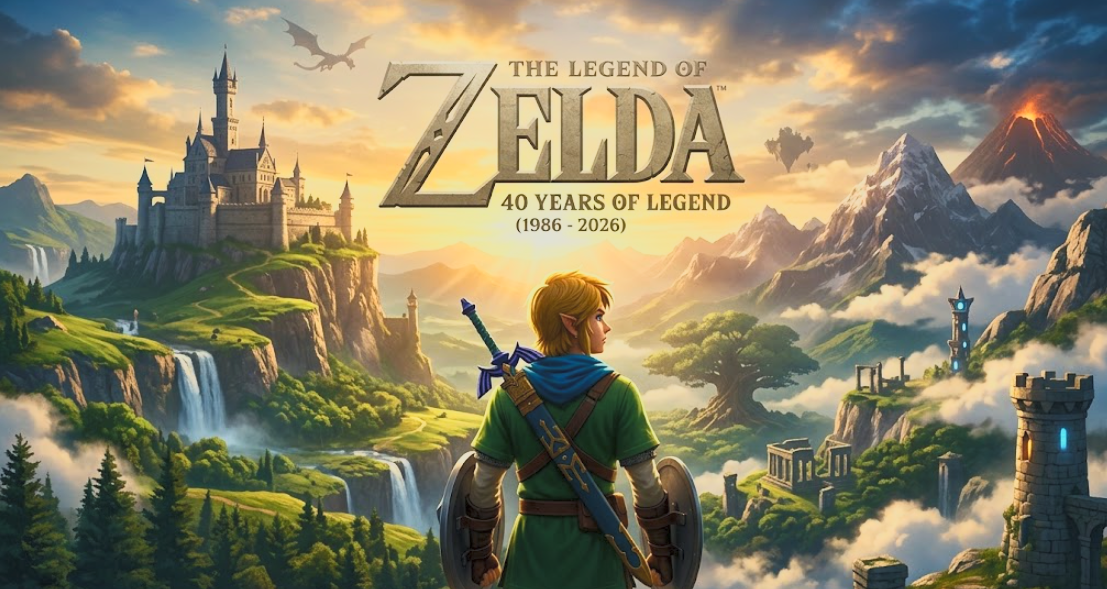
Four decades after the appearance of the very first kingdom of Hyrule, The Legend of Zelda saga remains one of the absolute pillars of the global video game industry. As we celebrate its 40th anniversary in 2026, the franchise stands as a masterclass in game design. Between profound structural reinventions, consistently bold artistic choices, and groundbreaking technical prowess, this series has never rested on its laurels.
This comprehensive retrospective explores the epic journey of a franchise that didn’t just become legendary—it actively shaped the language of modern gaming.
The Visionary Architects of Hyrule
The enduring history of the Zelda saga is not the result of a single happy accident, but rather the meticulous craftsmanship of visionary creators who understood how to evolve the core formula with every new console generation.
- Shigeru Miyamoto (The Founding Father): The inception of The Legend of Zelda is deeply rooted in Miyamoto’s childhood. Inspired by his youthful explorations of the intricate caves, dense forests, and hidden lakes surrounding Kyoto, he designed the original 1986 game around a pure sense of wonder. His vision was to give players an unguided feeling of discovery and adventure, dropping them into a hostile world with nothing but a sword and their own curiosity.
- Takashi Tezuka (The Storyteller): As the co-creator of the first game and the iconic director behind masterpieces like A Link to the Past and Link’s Awakening, Tezuka is the soul of the franchise’s narrative. He breathed life into the lore, infusing the world of Hyrule with a fairy-tale charm, moments of absurd humor, and a foundational script structure that subsequent games would build upon.
- Eiji Aonuma (The 3D Pioneer & Historic Producer): Arriving as a director for the dark and complex Majora’s Mask and the visually striking The Wind Waker, Aonuma eventually took the reins as the historical producer of the entire franchise. He is the principal architect of the series’ transition into the third dimension, and later, the driving force behind its modern metamorphosis into open-world systemic gameplay.
- Hidemaro Fujibayashi (The Modern Director): The visionary behind the recent canonical blockbusters (Skyward Sword, Breath of the Wild, Tears of the Kingdom), Fujibayashi successfully orchestrated the complete overhaul of the series’ gameplay. He shifted the focus toward physics-based interaction, verticality, and unparalleled creative freedom.
- Koji Kondo (The Musical Genius): A world-class composer whose legendary main theme, the mystical Triforce motif, and the unforgettable ocarina melodies have transcended the medium. His compositions for the series are now recognized as integral parts of international musical heritage, performed by symphony orchestras worldwide.
Chronology and the Evolution of Graphic Styles
Every single console generation has provided Nintendo with a blank canvas to completely reinvent both the aesthetics and the core mechanics of the series. The evolution of The Legend of Zelda can be categorized into four distinct, revolutionary eras.
1. The 2D & Pixel Art Era (1986 – 1993)
The foundations of action-adventure gaming were laid in the 8-bit and 16-bit eras.
- The Legend of Zelda (1986, NES): Released on the mythical golden cartridge, this inaugural title introduced a top-down perspective and total freedom of exploration. Its major innovation was the ability to save progress directly onto the cartridge via a battery backup—a necessity for an adventure of this unprecedented scale.
- Zelda II: The Adventure of Link (1987, NES): In a bold departure from the original, this sequel adopted a side-scrolling perspective and integrated heavy RPG elements, such as experience points and magic meters. It remains famous for its legendary difficulty and deeply influential combat system.
- A Link to the Past (1991, Super Nintendo): Widely considered the pinnacle of 16-bit pixel art, this masterpiece solidified the « dungeon-item-boss » formula that would define the series for decades. It innovated brilliantly by introducing the concept of two parallel worlds—the Light World and the Dark World—requiring players to shift between realities to solve environmental puzzles.
- Link’s Awakening (1993, Game Boy): Taking the hero out of Hyrule, this handheld adventure on Koholint Island offered a highly poetic, slightly surreal, and deeply melancholic narrative, proving that the Zelda formula could thrive perfectly on a monochromatic portable screen.
2. The 3D Transition and Thematic Maturity (1998 – 2006)
The leap into 3D required rewriting the rulebook, and Nintendo delivered historic results.
- Ocarina of Time (1998, Nintendo 64): This was a true 3D revolution. Ocarina of Time standardized 3D action-adventure controls by inventing « Z-Targeting »—a lock-on camera system that allowed players to circle enemies and defend intuitively. Combined with a time-travel narrative spanning two eras, it is frequently cited as the greatest video game of all time.
- Majora’s Mask (2000, Nintendo 64): Reusing its predecessor’s engine, this sequel plunged into a remarkably dark, anxiety-inducing atmosphere. It introduced a highly innovative 3-day time loop mechanic and a complex system of magical masks that fundamentally altered Link’s abilities and physical form.
- The Wind Waker (2002, GameCube): Initially controversial for its dramatic shift to a cartoon/anime Cel-Shading art style, this game has aged impeccably. It offered a vast oceanic world for maritime navigation and granted characters an unprecedented level of facial expressiveness and charm.
- Twilight Princess (2006, GameCube / Wii): Responding to fan desires for a darker, more realistic aesthetic, this entry featured a twilight-infused, chivalric atmosphere. Its dual-form gameplay, where Link transforms into a wolf to navigate the Twilight Realm, provided a fresh twist on traditional exploration.
3. The Era of Mobility and Painted Cel-Shading (2004 – 2013)
During this period, the franchise experimented heavily with unconventional control schemes and unique visual identities.
- The Minish Cap (2004, GBA) & Four Swords: Featuring incredibly refined and colorful sprites, The Minish Cap introduced the brilliant mechanic of shrinking down to the size of a bug to explore a macro-world hidden beneath the grass of Hyrule.
- Phantom Hourglass (2007) & Spirit Tracks (2009, Nintendo DS): These portable entries fully embraced the DS hardware, offering complete touchscreen playability via the stylus and focusing on unique modes of transport (a steamboat and a locomotive, respectively).
- Skyward Sword (2011, Wii): Visually inspired by impressionist paintings, this title served as the chronological origin story of the Zelda timeline, detailing the forging of the Master Sword. It heavily integrated 1:1 motion gaming via the Wii MotionPlus, turning every sword swing into a deliberate puzzle.
- A Link Between Worlds (2013, Nintendo 3DS): Acting as a direct homage and spiritual sequel to A Link to the Past, this game ran at a flawless 60 frames per second and introduced the ingenious mechanic of allowing Link to merge into walls as a 2D painting, creating mind-bending spatial puzzles.
4. The Revolution of Absolute Freedom (2017 – Today)
Realizing the traditional formula had become predictable, Nintendo tore it down to return to Miyamoto’s original 1986 vision of pure, unguided exploration.
- Breath of the Wild (2017, Switch / Wii U): This title marked a major rupture for the industry. Powered by a systemic « Chemistry Engine, » it offered an organic open world where fire burns wood, metal attracts lightning, and wind carries paragliders. It offered total freedom of exploration, allowing players to climb any surface and tackle the final boss immediately after the tutorial.
- Tears of the Kingdom (2023, Switch): Building upon its predecessor, this monumental sequel expanded the map vertically—adding an archipelago of sky islands and a terrifying, pitch-black subterranean Depths. Its major innovation was the « Ultrahand » (Emprise) system, a physics-based dynamic building mechanic that gave players limitless creative power to craft vehicles, weapons, and contraptions.
2026: Coming Full Circle with a Wink to the Past
As the franchise celebrates its 40th anniversary in 2026, the legacy comes full circle. To mark this historic milestone, Nintendo has returned to the game that defined the 3D era: the highly anticipated Ocarina of Time 2026 Remake for the newly launched Switch 2 console. This loving reimagining serves as a spectacular « clin d’œil » (a nod) to the fans. Built from the ground up, it perfectly merges the nostalgic magic of the 1998 original with the staggering graphical capabilities of modern hardware, ensuring that the Hero of Time’s legend resonates with a brand-new generation of gamers.
A Legacy of Constant Reinvention
When looking back at the canonical timeline—from the free exploration of the 1986 NES original, to the parallel worlds of the SNES, the 3D standard-setting of the N64, the stunning Cel-Shading of the GameCube, the motion controls of the Wii, the systemic physics of the Switch, and the gorgeous remakes of the Switch 2—one truth becomes brilliantly clear.
In exactly 40 years, The Legend of Zelda has achieved the impossible tour de force of never locking itself away in its own nostalgia. Instead of resting on a proven formula, the developers have consistently chosen to reinvent the very language of video games at every major stage of its history. And that is why the legend will never die.