Description
The television universe has undergone a true revolution over the past decade. At the heart of this transformation, Samsung has established itself as a major player, frequently dictating trends and pushing the boundaries of visual innovation. Today, choosing a screen is no longer just about selecting a diagonal size. It involves navigating an ocean of complex acronyms and technologies: OLED, Neo QLED, HDR, VRR, HDMI 2.1…
Whether you are a demanding cinephile seeking perfect contrast for your films, or a passionate gamer requiring flawless responsiveness for your video game sessions, understanding these technologies has become essential. This article decodes the latest innovations in Samsung televisions in depth, providing a clear, technical, and comprehensive overview of the best current market offerings.
1. Decoding Samsung Display Technologies
To understand the current lineup, one must first look at the panels themselves. Samsung does not rely on a single solution but offers different display technologies to meet distinct needs and environments.
The Strong Return with QD-OLED
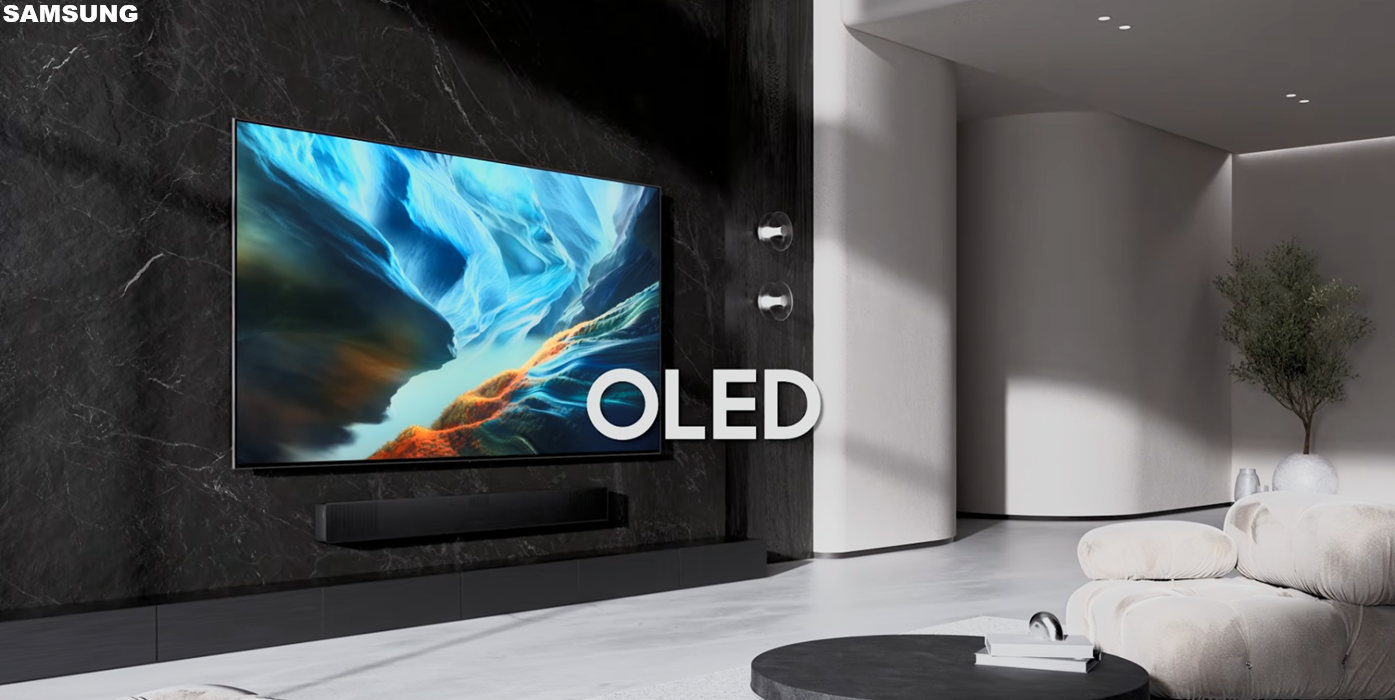
For a long time, Samsung focused on enhanced LCD (QLED), leaving traditional OLED (Organic Light-Emitting Diode) technology to its competitors. However, the South Korean firm recently made a massive comeback with its own iteration: QD-OLED (Quantum Dot OLED).
Standard OLED technology relies on self-emissive pixels. Each pixel produces its own light and can turn off completely, offering absolute blacks and a literally infinite contrast ratio. The historical issue with OLED resided in its peak brightness, which was sometimes insufficient in highly illuminated rooms.
This is where Samsung’s QD-OLED innovation steps in. By combining an OLED panel emitting pure blue light with a layer of « Quantum Dots » to generate red and green, Samsung achieves a technical masterpiece. This method eliminates the need for a traditional color filter (which absorbs light) and the white sub-pixel used by the competition. The result? A panel capable of displaying much more saturated, vivid, and accurate colors, while maintaining the deep blacks emblematic of OLED. The colorimetry at high brightness levels (color volume) is exceptional, making this technology ideal for highly demanding visual content.
Neo QLED: The Supremacy of Mini-LED
Alongside QD-OLED, Samsung continues to improve its LCD range through Neo QLED technology. This designation refers to LCD televisions equipped with Mini-LED backlighting and a Quantum Dot filter.
The mechanics of Mini-LED are fascinating. Unlike older LCD TVs that used a few dozen large diodes to illuminate the screen, Neo QLED integrates tens of thousands of miniature LEDs behind the panel. These LEDs are grouped into thousands of independent « Local Dimming » zones.
The screen’s processor analyzes the image in real-time and adjusts the intensity of each zone. If a part of the image is black (like deep space), the Mini-LEDs in that zone turn off almost completely, while the neighboring zone displaying a star will shine brightly.
The major advantage of Neo QLED over OLED is its phenomenal light output. These screens can reach dazzling brightness peaks, perfect for combating glare in a sun-drenched living room during the day. Furthermore, there is absolutely no risk of « burn-in » (screen image retention), a reassuring factor for those who watch continuous news channels or leave static interfaces displayed for long hours.
MicroLED: The Future Without Compromise
Although its price currently reserves it for an elite market, it is impossible to discuss Samsung without mentioning MicroLED. This technology combines the advantages of OLED (self-emissive pixels, infinite contrast) and LCD (extreme brightness, no burn-in risk) by using microscopic inorganic LEDs for each sub-pixel. It represents the holy grail of modern display technology, which will gradually become more accessible over the coming decade.
2. Home Cinema: The HDR Revolution
Having good colors and deep blacks is only part of the cinematic equation. The true visual revolution of recent years lies in the processing of image dynamics.
Understanding HDR (High Dynamic Range)
HDR (High Dynamic Range) has replaced the old SDR (Standard Dynamic Range). Practically, HDR allows a television to display a much wider range of brightness levels, from the deepest black to the most dazzling white, while preserving details in both extremes.
In an SDR film, a scene showing a character in the shadows with a sunny window behind them would force the screen to choose: either the character is visible but the window is a detail-less white block (overexposure), or the outside is visible but the character is just a black silhouette (underexposure). HDR solves this problem by simultaneously displaying details in dark areas and bright highlights.
Samsung’s Positioning with HDR10+
Samsung relies heavily on the HDR10+ standard. Unlike basic HDR10, which applies a single metadata set for the entire film, HDR10+ uses dynamic metadata. This means brightness and contrast instructions are sent to the television scene by scene, or even frame by frame. The screen constantly adapts its capabilities to render exactly what the director intended.
Paired with the brand’s QD-OLED and Neo QLED panels, the cinematic rendering is masterful. Dark scenes are full of subtle nuances, while pyrotechnic effects or sun reflections genuinely dazzle the viewer. The « Neural Quantum » processor integrated into high-end models uses artificial intelligence to upscale older HD content to 4K, while simulating an HDR effect on SDR sources, breathing new life into cinema classics.
3. Video Gaming: Fluidity, Responsiveness, and Embedded Technologies
While cinema demands fidelity, modern video gaming demands reactive technology. Next-generation consoles (PS5, Xbox Series X) and high-performance PCs output complex video signals that the screen must process in a fraction of a second. Samsung has built a solid reputation among gamers by consistently integrating the most advanced technologies.
The Magic of VRR (Variable Refresh Rate)
In the gaming realm, the graphics card calculates a certain number of frames per second (FPS). This number is never static: a quiet scene might run at 60 FPS, while a complex explosion drops the rate to 45 FPS.
Previously, if the television had a fixed refresh rate (e.g., 60 Hz), this desynchronization between the console and the screen caused screen tearing (unpleasant visual splitting) or stuttering (micro-lags).
VRR (Variable Refresh Rate) allows the television to dynamically map its own refresh rate to that of the console or PC. If the game runs at 53 FPS, the screen instantly adjusts to 53 Hz. The result is absolute fluidity, without any visual tearing. Samsung televisions support the most advanced iterations of this technology, notably the standardized HDMI 2.1 format, as well as AMD FreeSync Premium Pro.
HDMI 2.1 and Extreme Refresh Rates
To transport these massive data loads (high-frequency 4K), high bandwidth is required. Recent Samsung TVs integrate up to four HDMI 2.1 ports. These ports allow gaming in 4K at 120 Hz, which is the standard for modern consoles.
Samsung goes even further, particularly for PC gamers. The highest-performing QD-OLED and Neo QLED models feature Motion Xcelerator technology, allowing them to reach up to 144 Hz, or even 165 Hz in 4K resolution. This technical feat guarantees impeccable motion clarity in fast-paced competitive games like first-person shooters (FPS) or sim racing.
Input Lag: The Obsession with Response Time
Input Lag measures the time elapsed between the moment a player presses a button on their controller and the moment the action appears on the screen. Too high of a delay makes the game unplayable, giving a sensation of sluggishness.
Thanks to the Auto Low Latency Mode (ALLM), Samsung screens disable all unnecessary image processing (such as motion smoothing for movies) as soon as a console is powered on. This drops the input lag to under 10 milliseconds, an exceptional figure that ensures optimal responsiveness for esports and games requiring lightning-fast reflexes.
The Gaming Hub: Playing Without a Console
Samsung has also reimagined gaming accessibility with the introduction of the Samsung Gaming Hub in its Tizen operating system. This platform gathers all cloud gaming services (Xbox Game Pass, NVIDIA GeForce NOW, etc.). Users simply need to connect a Bluetooth controller directly to the television, and with a solid internet connection, they can play the latest AAA titles without even owning a physical console or PC. This represents a major evolution in how video game media is consumed.
4. OLED vs. Neo QLED: Which is the Optimal Choice?
Faced with this flood of technologies (VRR, HDR10+, 144Hz, AI), one question remains: should you lean toward QD-OLED or Neo QLED? The answer depends entirely on your room’s environment and your usage habits.
-
Opt for QD-OLED if: You prioritize viewing or gaming sessions in the evening, in a dimly or moderately lit room. If you seek the absolute perfection of blacks, striking contrast for science fiction films or video games with dark atmospheres (horror games, space RPGs), and extraordinarily rich colorimetry. This is the screen for image purists.
-
Opt for Neo QLED if: Your living room is bathed in natural light, featuring large windows. If you watch a lot of daytime sports or game in a brightly lit environment, the raw luminous power of Mini-LED works wonders to counter glare. It is also an excellent, reassuring choice for those who intend to use their television as a static PC monitor all day without fearing any image retention.
Purchasing a television should never be left to chance. Samsung has structured its lineup so that cinema lovers and video game enthusiasts can find equipment meeting their strictest requirements. By mastering the duality of its offerings—the hypnotic depth of OLED coupled with Quantum Dots on one side, and the radiant power of Neo QLED backed by Mini-LED on the other—the South Korean manufacturer covers the entire audiovisual spectrum. Paired with flawless integration of modern standards like HDR10+, VRR, and high-bandwidth HDMI 2.1, these televisions no longer merely broadcast images: they construct genuine immersive windows, capable of transcending your favorite films and amplifying your performance with a controller in hand.