
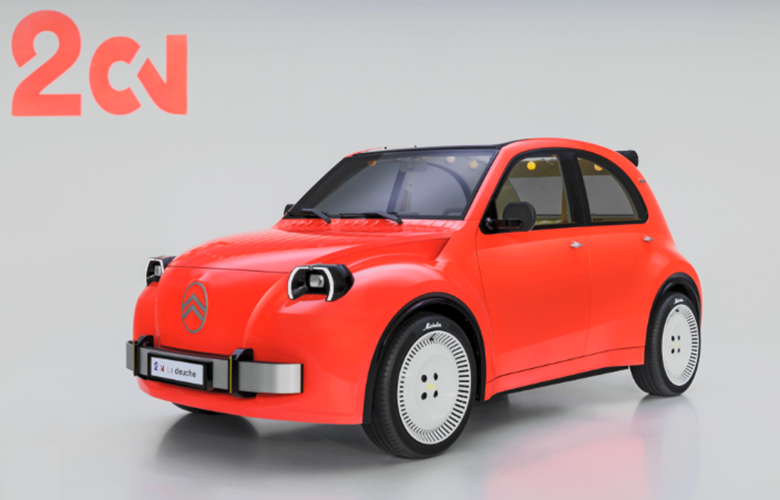
The automotive industry is witnessing a powerful blend of nostalgia and technological revolution. Seventy-eight years after its historic debut at the 1948 Motor Show, the legendary « Deuche » is making a spectacular comeback. At the 2026 Paris Motor Show (Mondial de l’Auto), running from October 12 to 18, the French automaker stole the spotlight by unveiling the highly anticipated Citroën 2CV Concept. This all-new, 100% electric 2CV is introduced as an affordable, clever, and endlessly charming city car—designed to tackle modern mobility challenges while reigniting a deep sense of automotive nostalgia.
This comprehensive guide dives into the details of the new 2026 electric Citroën 2CV, from its bold design to its technical specs, while taking a look back at the fascinating legacy of the mythic car that once motorized all of France.
The Grand Unveiling at the 2026 Paris Motor Show
During a special preview event on Sunday evening, October 11, 2026—just before the official public opening—Citroën pulled the covers off this much-anticipated concept car. Sporting a vibrant orange paint job that instantly catches the eye, the vehicle proudly ditches the internal combustion engine. According to early observers who got up close, this bold prototype is estimated to be 90% true to the final production model.
Citroën’s goal with this new electric 2CV is crystal clear: to offer a daily driver that is simple, practical, and eco-friendly, all wrapped in a striking design that capitalizes on the brand’s rich heritage. At a time when electric vehicles (EVs) are still struggling to democratize their pricing, Citroën is making massive waves at the Paris Motor Show by promising unprecedented affordability for a model carrying such historical weight.
Retro Design and Lines: A Masterful Tribute
The design of the new electric Citroën 2CV is a masterclass in balancing historical homage with functional modernity. The concept retains numerous signature traits of its ancestor that are guaranteed to make purists smile. The instantly recognizable rounded silhouette, pronounced fenders, and strictly vertical windshield are all present, leaving no doubt about its lineage.
Despite its imposing look in photos, the car is incredibly compact. Measuring just 3.76 meters (12.3 feet) in length, this 2CV Concept is paradoxically even shorter than the original! This ultra-compact footprint was specifically engineered to weave through tight urban traffic and make city parking a breeze.
Citroën’s designers pushed the retro callbacks to the limit. The legendary canvas roof is back, fully capable of rolling backward for an open-air driving experience. On the sides, the vehicle sits on 18-inch steel-look wheels framed by black wheel arches that keep the visual profile perfectly balanced. At the rear, the roofline gently slopes down to a black tailgate extending to the bumper.
The bodywork’s engineering favors industrial simplicity, nodding to the car’s utilitarian roots. The surfaces are mostly flat, air intakes are cleverly tucked under the windshield, and the bumpers are separated from the main bodywork to make them cheaper to manufacture and replace. The ultimate easter egg for fans? The horn and the low-speed electric motor sound have been synthesized to mimic the iconic clatter of the original 2CV’s flat-twin engine.
A Minimalist and Ingenious Cabin
The interior of the 2026 Citroën 2CV follows the exact same philosophy as the exterior: keep it simple and practical while integrating today’s tech. The cabin is refreshingly minimalist and heavily inspired by the original. The automaker has brought back the bench seat layout for both the front and rear—an absolute staple of « Deudeuche » comfort. Interestingly, the front bench can be entirely removed from the cabin, though it remains to be seen if these lightweight mounts will pass modern safety crash tests for the production version.
Digitally speaking, Citroën doesn’t skip connectivity but integrates it with a vintage twist. Driver information is displayed on a small cluster attached directly to the steering column, dubbed « Citroën Smart Vision. » This is paired with an 8-inch square central touchscreen, while a retro-styled « radio » module sits directly in front of the passenger. To complete the illusion, the gear selector (for the electric drivetrain) is mounted on the steering wheel, perfectly mimicking the iconic push-pull shifting motion of the classic 2CV.
Technical Specs: Betting on a Featherweight Build
While many automakers are caught in an arms race for range—resulting in incredibly heavy vehicles packed with massive batteries—Citroën has chosen the path of lightness. The manufacturer is targeting a curb weight of around one metric ton. It is crucial to note that this is not a heavy quadricycle (like the Citroën Ami), but a fully homologated, highway-legal passenger car.
This ruthless weight-saving strategy allows Citroën to significantly reduce the size, weight, and—most importantly—the cost of the battery pack. Although official final numbers haven’t been released at the 2026 Paris Motor Show, industry estimates point to a WLTP range of between 100 and 150 kilometers (62 to 93 miles). Combined with an electric motor providing « sufficient » power, this electric 2CV is strictly tailored for daily commutes, short urban trips, and local rural drives rather than cross-country road trips.
Pricing and Launch: An Affordable EV at €15,000
The real triumph of this new Citroën 2CV is its targeted price tag. The brand’s openly stated goal is to bring the final production model to market with a starting price of around €15,000, before any government EV incentives or eco-bonuses are applied.
For context, Citroën’s own recently launched ë-C3 starts at €20,390, meaning the future 2CV would undercut it by more than €5,000. If this €15,000 baseline is maintained—and considering it will likely be manufactured in Europe—subsidies could drive the final cost down even further. This would make it an incredibly competitive option for households looking for a stylish second car or an affordable daily commuter. Naturally, this aggressive pricing is still contingent on final industrial and regulatory decisions.
As for the release date, fans will need to be a little patient. While the concept car is the star of October 2026, the final production version is expected to be unveiled in 2027, with official showroom availability targeted for 2028.
The Legacy of the Citroën 2CV: 1948 to Present
It is impossible to fully appreciate the impact of this new concept without looking back at the rich history of the original Citroën 2CV. The story began in the 1930s under the leadership of Pierre-Jules Boulanger. The design brief for the TPV (Toute Petite Voiture or « Very Small Car ») project was as precise as it was unusual: build a car capable of carrying four people and 50 kilos of potatoes at 60 km/h, while sipping only 3 liters of fuel per 100 km. Legend has it the suspension had to be soft enough to drive across a plowed field with a basket of eggs on the seat without breaking a single one!
Unveiled to the world at the 1948 Paris Motor Show, the 2CV initially drew shock and even mockery from the press before becoming an absolute commercial triumph. Affordable, economical, bulletproof, and easily repairable, the « Deuche » mobilized post-war France—from farmers and students to country doctors and families. Its exceptionally long career spanned over four decades, finally ending production in 1990. Today, its purpose has evolved: it is no longer the do-it-all farm vehicle, but a symbol of smooth, decarbonized urban mobility.
The Electric Neo-Retro Battle
With this electric 2CV, Citroën is diving headfirst into the massive neo-retro trend currently sweeping the European automotive industry. The market has repeatedly proven that nostalgia sells. This is evident in the smash-hit electric reboots of the Fiat 500 and the Mini, the highly publicized launch of the Renault 5 E-Tech, and the upcoming Renault Twingo E-Tech.
Citroën, which has previously dabbled in neo-retro designs with mixed results (think of the Revolt concept or the commercial flop of the E-Mehari), seems to have finally found the magic formula. By pairing an evocative silhouette that resonates across generations with highly pragmatic technological choices (small battery, ultra-lightweight), the brand is creating a truly unique value proposition.
Conclusion: A Bright Future for the Electric 2CV?
The return of the Citroën 2CV as an electric concept at the 2026 Paris Motor Show is undoubtedly one of the biggest automotive announcements of the year. By channeling the accessibility, lightness, and ingenuity of its illustrious ancestor, this model could completely disrupt the affordable EV market when it officially launches in 2028. If the automaker delivers on its €15,000 promise with a vehicle packing this much personality, the new « Deuche » is perfectly poised to win over the hearts of drivers and quietly conquer our streets all over again.