The 2026 Paris Motor Show (Mondial de l’Auto), hosted at Paris Expo Porte de Versailles from October 12 to 18, marks a decisive turning point in the history of the global automotive industry. Following years of transition dominated by heavy, high-priced electric vehicles out of reach for the average consumer, the 2026 edition firmly establishes the era of affordable electromobility and neo-retro design. Automakers have clearly heard the market: this year’s show shines a spotlight on budget-friendly city cars, compact crossovers, and clever concept vehicles engineered to truly democratize zero-emission driving.
This comprehensive guide delivers an in-depth breakdown of the primary trends at the 2026 Paris Motor Show, the major brands on the floor, and the flagship vehicles reshaping our roads for years to come.
Key Trends Shaping the 2026 Paris Motor Show
The 2026 event revolves around three major strategic pillars that define the roadmap for every exhibiting manufacturer.
- The Battle for the Sub-€20,000 Electric Car: This is the ultimate industry battleground. Under growing competitive pressure from Asian manufacturers, European automakers are finally unveiling production-ready EVs priced between €15,000 and €20,000 before government incentives. Falling manufacturing costs for Lithium Iron Phosphate (LFP) batteries and streamlined modular platforms have enabled brands to hit this critical psychological price barrier.
- The Triumph of Neo-Retro Design: Nostalgia has proven to be a formidable marketing catalyst. Brands are leaning heavily into their heritage by resurrecting iconic nameplates from the past, completely reimagined with all-electric powertrains and state-of-the-art connected cabins.
- Efficiency Over Massive Range: The arms race for heavy 100 kWh batteries is officially over. Today’s priority is weight reduction, optimized aerodynamics, and right-sized battery packs (typically 40 to 50 kWh). These setups deliver real-world ranges of 300 to 400 km (185 to 250 miles), which is more than sufficient given the rapid expansion of ultra-fast charging networks across Europe.
The Home Turf Offensive from French Automakers
Exhibiting on home soil, French brands are taking center stage at the 2026 show with sprawling exhibits and major strategic debuts.
Citroën: Shockwaves with the New Electric 2CV
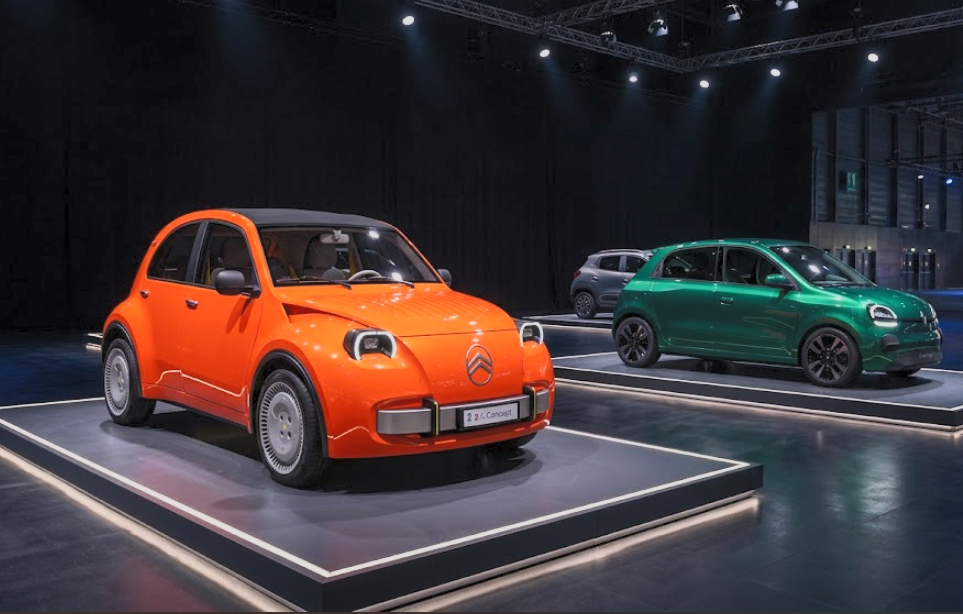
Citroën delivered the undisputed headline moment of the show with the world premiere of the Citroën 2CV Concept. Seventy-eight years after the original model debuted in Paris, the brand has resurrected the legendary « Deuche » as a 100% electric city car. Targeting an aggressive entry-level price point near €15,000, this lightweight vehicle—weighing close to just one metric ton—prioritizes functional simplicity and clever engineering. Featuring a roll-back canvas roof, instantly recognizable rounded fenders, and an estimated range of 100 to 150 km, it positions itself as the ultimate urban runabout, reigniting the price war against entry-level competitors.
Alongside the 2CV, Citroën is expanding its lineup with the production version of the electric C3 Aircross, delivering maximum cabin space for families at a accessible price, while rolling out major tech upgrades for the compact ë-C4.
Renault: Leveraging Nostalgia for Mass Electrification
Renault Group continues its « Renaulution » strategy with a sweeping product offensive, reinforcing its position as a European market leader in compact EVs.
- Renault Twingo E-Tech: Making its official public debut in production form, the new electric Twingo channels the cheeky design of the original 1990s generation. It promises class-leading energy efficiency and a sub-€20,000 starting price.
- Renault 5 and Renault 4 E-Tech: The R5 EV, already a commercial success, is showcased with new battery configurations and premium trim levels. Beside it, the new Renault 4 (4L) takes the form of a rugged, utilitarian crossover built for urban adventures with exceptional interior modularity.
- Alpine: The group’s performance brand is showcasing the A290, its hot-hatch evolution of the R5, along with a striking new electric GT crossover concept, signaling its ambitions as an all-electric global brand.
Peugeot: Feline Design Meets Cutting-Edge Tech
Peugeot is focusing heavily on emotional design and digital cockpit integration, displaying its latest generation of vehicles fitted with the Panoramic i-Cockpit.
- Refreshed Peugeot E-208: The best-selling electric supermini receives a bolder visual identity featuring sharper triple-claw light signatures and an upgraded powertrain pushing range past the 400 km mark.
- E-3008 and E-5008 Family: The lion brand’s flagship SUVs demonstrate the capabilities of Stellantis’s STLA Medium architecture, offering up to 700 km of range in long-range variants—a major selling point for highway drivers.
European Heavyweights: Securing the Premium and Volume Segments
Major European brands—particularly German and Italian automakers—are deploying comprehensive lineups to meet demand across every vehicle class.
Volkswagen Group: The Moment of Truth for the ID Family
Volkswagen is focused on regaining market share in the high-volume compact segment. Paris serves as the stage for the production-ready Volkswagen ID.2. Expected to launch around €25,000 with a more classic design language than earlier ID models, this compact EV aims to become the « Golf of the electric age. »
Skoda is highlighting the Epiq, a highly practical compact electric SUV, while Cupra presents the Raval—the sporty technical sibling to the ID.2, featuring aggressive styling tailored for a younger demographic.
Stellantis (International Brands): Fiat and Opel Step Up
Fiat is making waves with the debut of the Grande Panda. Drawing inspiration from the blocky, utilitarian lines of the iconic 1980s original, this compact city car shares its platform with the Citroën ë-C3. It targets high-volume markets across Southern Europe and Latin America with a durable, colorful, and budget-friendly package.
Opel reinforces its German engineering identity with the reveal of the all-electric Opel Frontera. Replacing the Crossland, this family SUV stands out with clean surfaces, the signature « Vizor » front fascia, and a spacious cabin capable of seating up to seven passengers.
BMW and Mercedes-Benz: Redefining Electric Luxury
Germany’s premium manufacturers continue to forge their own paths, emphasizing software innovations and advanced drivetrain efficiency.
- BMW: The Bavarian brand is showcasing its first production-ready models built on the revolutionary « Neue Klasse » platform. The design language marks a clean break from the past, featuring minimalist lines, interactive illuminated kidney grilles, and pillar-to-pillar panoramic head-up displays.
- Mercedes-Benz: The Three-Pointed Star is presenting the new electric CLA. Featuring an 800-volt electrical architecture for ultra-fast charging (adding up to 400 km of range in just 15 minutes) and benchmark efficiency hovering around 12 kWh/100 km, it sets a new standard for compact executive sedans.
The Dominant Presence of Asian Automakers
The 2026 edition highlights the permanent foothold Asian manufacturers—particularly Chinese brands—have established in Europe. Their massive exhibition spaces rank among the largest at the show.
BYD: The Global Push
Now an established automotive powerhouse, BYD (Build Your Dreams) is expanding beyond value pricing. The brand is showcasing the Seagull, an ultra-compact EV poised to disrupt Europe’s entry-level segment. Simultaneously, BYD is displaying its 5th-generation plug-in hybrid technology, capable of delivering combined driving ranges exceeding 2,000 km—a compelling bridge for buyers not yet ready for pure battery-electric vehicles.
MG Motor: Solidifying Market Gains
Building on the success of the MG4, MG Motor is pulling the sheet off the next-generation ZS EV crossover, featuring a redesigned exterior and an upgraded infotainment system. The brand is also showcasing the Cyberster roadster, proving that electric powertrains can deliver genuine sports car excitement.
New Tech-First Entrants: Xpeng and Nio
Xpeng is drawing crowds with its feature-packed electric SUVs equipped with advanced Level 3 autonomous driving capabilities powered by in-house software architectures. Meanwhile, Nio continues to push its proprietary Battery Swap technology, presenting next-generation swapping stations designed for rapid deployment across European highway corridors.
Technological Breakthroughs and Future Mobility
The 2026 Paris Motor Show extends far beyond sheet metal and horsepower; it serves as a global technology hub revealing the future of personal transport.
The Rise of Software-Defined Vehicles (SDVs)
The 2026 automobile is effectively a computer on wheels. The concept of the Software-Defined Vehicle is everywhere on the show floor. Manufacturers are displaying cars whose core functions—from battery thermal management to advanced driver assistance systems (ADAS)—continuously evolve via over-the-air (OTA) software updates. Furthermore, generative AI integration within voice assistants allows drivers to naturally plan multi-stop charging routes, manage smart home devices from the cabin, or run real-time vehicle diagnostics.
Sustainable and Circular Materials
Traditional leather and petroleum-based plastics are rapidly being phased out. Displays across the hall emphasize recycled and bio-sourced materials. Interiors feature seat upholstery woven from ocean-bound plastic bottles, dashboards crafted from hemp and flax fibers, and vegan leathers derived from mycelium (mushroom) and apple waste. This shift reflects an industry-wide commitment to reducing a vehicle’s total carbon footprint across its entire lifecycle, rather than focusing solely on tailpipe emissions.
The 2026 Paris Motor Show will be remembered as the event where electric mobility reached full maturity. Unnecessary complexity and prohibitive price tags have given way to practical, stylish, and genuinely accessible vehicles. Supported by the return of timeless icons like the Citroën 2CV, Renault 4, and Fiat Panda—alongside fierce competition from Asian brands and continuous software innovation—the automotive industry has demonstrated remarkable resilience. Visitors at Porte de Versailles are witnessing cars that are no longer distant futuristic concepts, but the practical, affordable reality of tomorrow’s transportation.