Television has always been the technological mirror of its time. Since its invention, this object reigning at the center of our living rooms has undergone spectacular mutations. From a simple wooden box broadcasting blurry black and white images, the television has transformed into a true interactive digital hub, ultra-thin and connected, capable of displaying breathtakingly realistic images in Ultra High Definition (4K and 8K). This in-depth article traces the fascinating history of television evolution, from the first analog broadcasting standards to the connected panels of tomorrow, including the rich history of connections (SCART, RCA, RGB, HDMI) that have linked our devices across the decades.
The Origins: From Black and White to the Color Revolution
The history of consumer television truly begins in the post-war years, with the democratization of cathode ray tube (CRT) screens. At that time, the TV signal was purely analog, consisting of waves transmitting luminosity intensities, which translated on the screen into shades of gray.
The transition to color was a major engineering challenge. It was necessary to broadcast a color signal without making the millions of black and white televisions already installed in homes obsolete. Engineers solved this problem by separating the signal into two components: luminance (the black and white signal, or « luma ») and chrominance (the color information, or « chroma »). Thus, a black and white television simply ignored the chrominance signal, while a color television combined the two to recreate the primary colors red, green, and blue (RGB) on the screen’s phosphor. This technical feat allowed for a smooth transition in the 60s and 70s, although color televisions remained luxury products for many years.
The Analog Era and the Cult of Connections: SCART, RCA, and RGB
In the 80s and 90s, television became the center of a growing ecosystem of peripheral devices: VHS VCRs, the first DVD players, and, of course, video game consoles. This multiplication of sources made the issue of connectivity crucial.
This is where a French invention that became legendary in Europe comes into play: the SCART connector (known as Péritel in France). Imposed on all televisions sold in France from 1980 onwards, this large rectangular 21-pin plug was a small marvel of integration for its time. It allowed the simultaneous transmission of stereo sound, composite video, and, above all, the famous RGB (Red Green Blue) signal. The latter offered significantly superior image quality, with each primary color having its own transmission channel, thus avoiding the color bleeding typical of composite signals.
Across the Atlantic and on entry-level equipment, the standard was instead the RCA cable, recognizable by its three plugs (yellow for composite video, red and white for stereo sound). While practical, composite RCA mixed all video information on a single cable, often offering a blurry image quality compared to a pure RGB signal.
The Digital Disruption: Flat Screens and the HDMI Revolution
The arrival of the 21st century marks a radical turning point with the gradual abandonment of the cathode ray tube in favor of flat screen technologies: Plasma, then LCD (often LED-backlit). This unprecedented thinness was accompanied by a fundamental paradigm shift: the transition from an analog signal to a digital signal.
It was in this context that the HDMI (High-Definition Multimedia Interface) standard was born. Unlike SCART, the HDMI port carries uncompressed video and audio streams in digital form (0s and 1s), avoiding any loss of quality associated with digital-to-analog conversion. HDMI quickly replaced the SCART transmission standard. For retrogaming enthusiasts wishing to plug an old console into a modern television, a simple cable is no longer enough: the two standards being incompatible, it is now imperative to use an active converter to transform the analog SCART signal into a digital signal readable by the HDMI port.
The Race for Resolution: HD, Full HD, and the Advent of 4K
With digital technology and flat screens, panel sizes began to grow, making the flaws of standard definition (SD) unbearable to the human eye. The industry then launched the great pixel race.
We first moved to High Definition (HD 720p), then quickly to Full HD (1080p), offering a resolution of 1920×1080 pixels. But the true current standard for an optimal visual experience is 4K (Ultra HD).
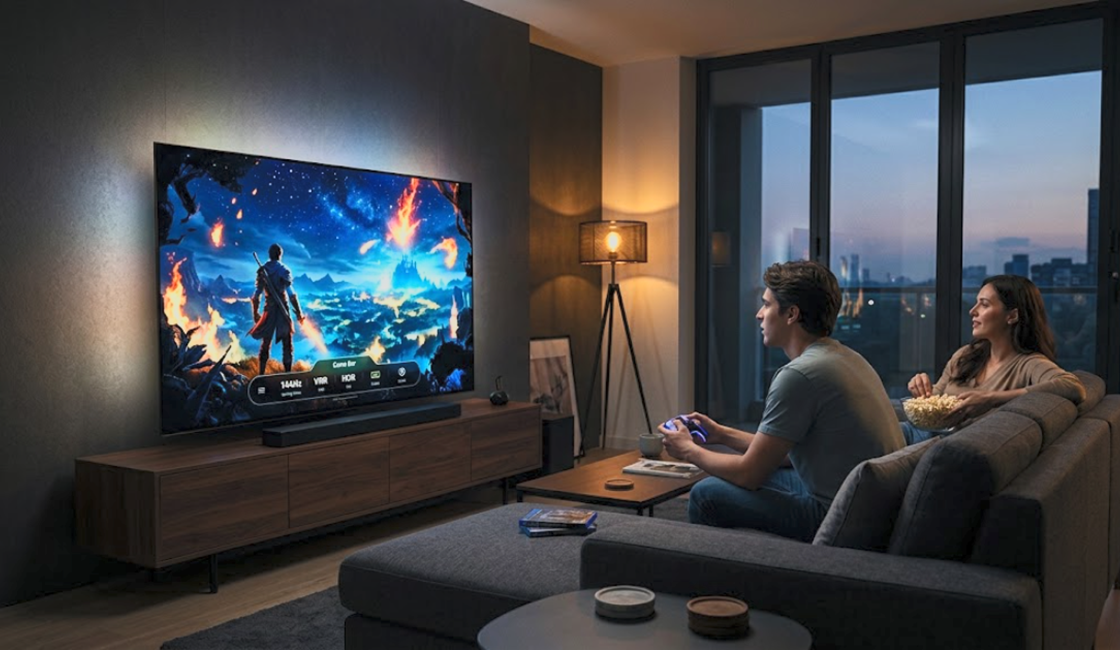
With its 3840×2160 pixels, 4K displays four times more detail than Full HD. This exceptional pixel density has allowed manufacturers to offer ever-larger televisions (55, 65, 77 inches and more) without the user being able to distinguish the pixels with the naked eye. The adoption of 4K was accelerated by streaming platforms and the advent of image enhancement technologies like HDR (High Dynamic Range), which multiplies the contrast and richness of colors in dark and bright areas.
At the same time, display technologies have continued to improve. OLED, capable of individually deactivating each pixel to achieve absolute blacks, and QLED (based on Quantum Dots) have pushed the boundaries of contrast and brightness.
The Smart TV: When the Television Becomes the Connected Heart of the Home
Alongside the race for the image, television has undergone another equally decisive revolution: connectivity. Starting in 2011, manufacturers began integrating their own operating systems (like Tizen at Samsung) to make televisions « smart. »
The Smart TV was born. Gone are the days when the television was a simple passive monitor waiting for a signal from an antenna or a decoder. Equipped with powerful processors, memory, and a Wi-Fi or Ethernet connection, the television becomes an autonomous device. It downloads applications, accesses the endless catalogs of SVOD services (Netflix, Amazon Prime, Disney+), allows web browsing, enables Cloud Gaming without a console, and integrates voice assistants (Google Assistant, Alexa) to interact with home automation. The television is today a computer specialized in entertainment.
The 8K Horizon and Beyond: Absolute Immersion
While 4K has established itself in our living rooms, the industry is already turning its gaze toward the next frontier: 8K television.
8K resolution (7680×4320 pixels) represents 16 times the resolution of the original Full HD. On paper, the advantages are impressive: images of unparalleled sharpness allowing viewers to watch very large screens from very close, creating a sense of depth that almost erases the boundary between the real and the virtual.
However, as the specialized press points out, 8K still raises major challenges. Native content is extremely rare. To compensate, 8K televisions integrate powerful Artificial Intelligence algorithms responsible for « upscaling » 4K content to 8K. Furthermore, streaming true 8K video requires very high internet bandwidths (several tens of megabits per second), and the prices of these premium televisions remain high.
Nevertheless, the future prospects for displays are bright. With the development of new technologies like Micro-LED, which combines the advantages of OLED (absolute blacks) and LED (extreme brightness without the risk of burn-in), televisions will continue to evolve to offer digital windows of striking realism.
From the capricious small square black and white box to the thin connected panel capable of displaying tens of millions of pixels, the evolution of television is one of the most beautiful pages in the history of consumer technology. It continues, year after year, to redefine how we consume the world.